
How many expats live in Portugal? At the end of 2025 the answer was 1,585,854 foreign residents, according to the latest official figures from AIMA, the Portuguese immigration agency. They include 47,726 British nationals, 21,293 Americans and 167,124 foreign residents in the Algarve.
AIMA published its Migration and Asylum Report 2025 (Relatório de Migrações e Asilo 2025) in September 2026, in Portuguese only. I have pulled out the figures that matter most to English-speaking expats, and set out what they mean for your finances if you are one of the people behind them.
| At 31 December 2025 | Figure |
|---|---|
| Foreign residents in Portugal | 1,585,854 |
| Change on 2024 | +2.7% |
| British residents | 47,726 |
| American residents | 21,293 |
| New residence permits granted in 2025 | 337,880 |
| Investment (golden visa) permits granted in 2025 | 2,685 |
| Foreign residents in the Algarve (Faro district) | 167,124 |
How many expats live in Portugal?
1,585,854 at 31 December 2025. The foreign population has almost quadrupled since 2017, when it stood at 421,802. Growth slowed sharply in 2025, however, to 2.7% from 18.3% the year before.
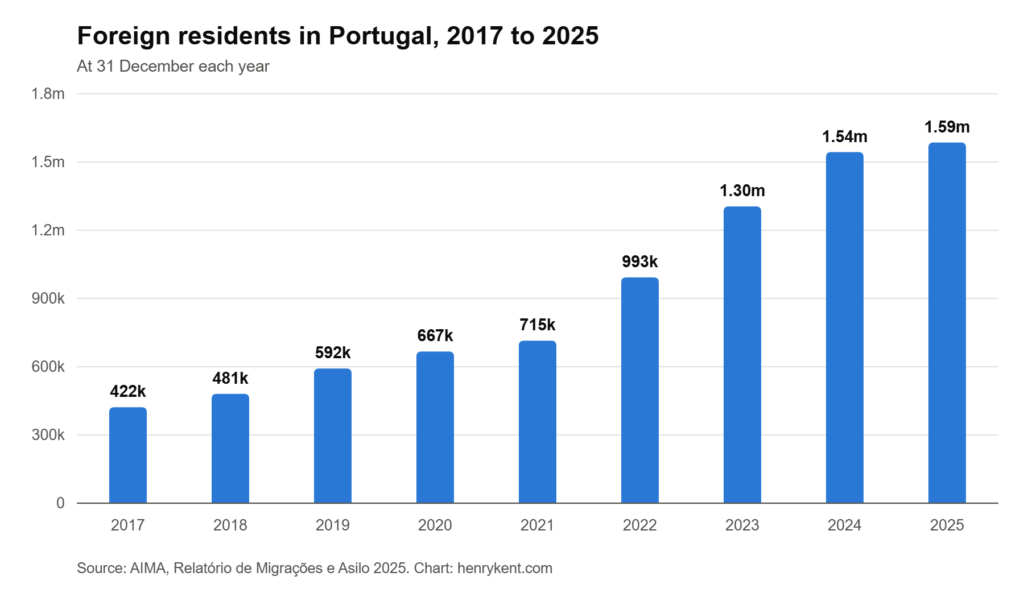
AIMA counts people with a valid residence permit, people whose applications are still being processed, and people covered by specific legal schemes, such as the 66,740 living here under temporary protection. Brazilians remain by far the largest community, with 31.1% of the total.
| Largest foreign communities, 2025 | Residents |
|---|---|
| Brazil | 493,622 |
| Angola | 99,050 |
| India | 91,405 |
| Ukraine | 84,889 |
| Cape Verde | 71,005 |
| Nepal | 56,304 |
| Bangladesh | 55,579 |
| Guinea-Bissau | 51,935 |
| United Kingdom | 47,726 |
| Italy | 42,418 |
How many British people live in Portugal?
47,726 British nationals lived in Portugal at the end of 2025. That makes the British the ninth-largest foreign community and the second-largest European one, after Ukrainians. Roughly one foreign resident in 33 is British.
During 2025, AIMA granted new residence permits to 2,542 British nationals. Another 252 received an investment (golden visa) permit, the third-highest of any nationality.
How many Americans live in Portugal?
21,293 at the end of 2025. Americans are a smaller community than the British, but in 2025 AIMA granted them 4,448 new residence permits, 75% more than British nationals. They were also the leading nationality for investment residence permits, with 535 of the 2,685 granted.
Residents from North and Central America as a whole rose 10% in the year, against 2.7% for foreign residents overall. Americans face a different set of financial rules from other expats, because the US taxes its citizens wherever they live. I cover this in Investing as an American in Portugal.
British, American and other expat communities compared
This is how many expats live in Portugal from the main English-speaking and northern European countries, and how many received new residence permits in 2025.
| Nationality | Residents, end 2025 | New permits in 2025 |
|---|---|---|
| United Kingdom | 47,726 | 2,542 |
| France | 29,794 | 4,229 |
| Germany | 26,715 | 3,944 |
| United States | 21,293 | 4,448 |
| Netherlands | 16,154 | 2,105 |
| Belgium | 7,595 | 921 |
| Ireland | 6,636 | 927 |
| Sweden | 6,326 | 521 |
| Switzerland | 4,175 | 467 |
| South Africa | 3,756 | 680 |
| Canada | 3,123 | 584 |
| Australia | 1,138 | 157 |
How many expats live in the Algarve?
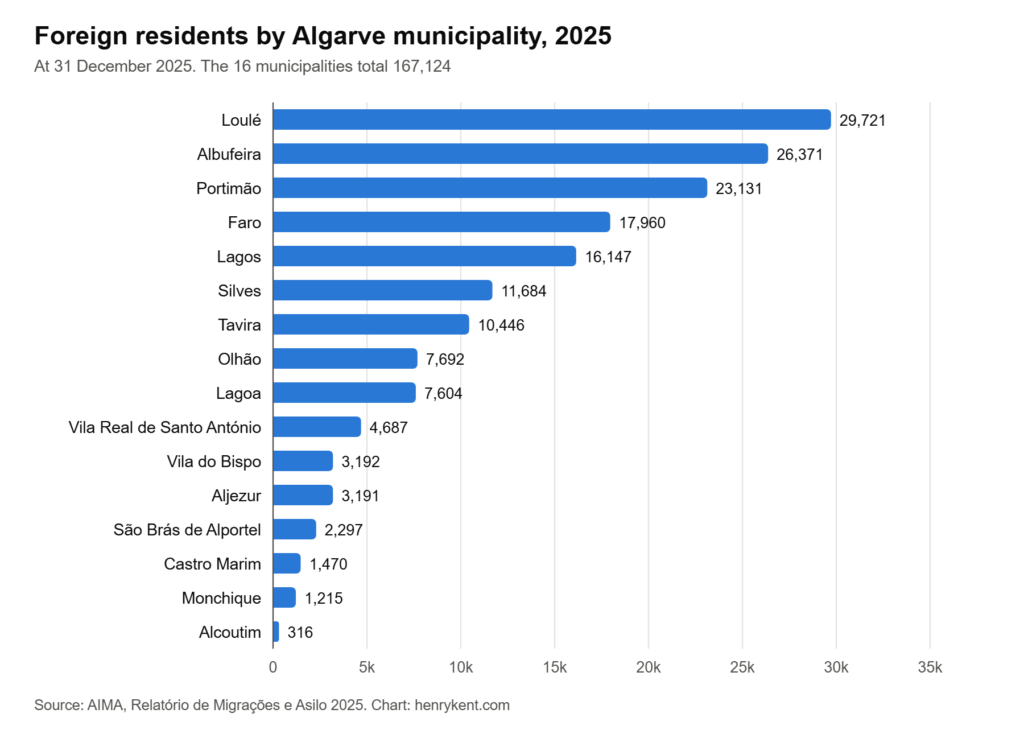
167,124 foreign residents lived in the Faro district, which covers the Algarve, at the end of 2025. That is 10.5% of all foreign residents in Portugal. Together with the Lisbon, Setúbal and Porto districts, it accounts for 70.3% of the country’s foreign population.
Loulé has the most, with 29,721, which puts it 11th among all Portuguese municipalities. Albufeira, Portimão, Faro and Lagos follow.
Golden visa figures for 2025
Golden visa holders are a small part of the answer to how many expats live in Portugal. AIMA granted 2,685 investment residence permits, the golden visa, in 2025, and a further 3,967 to family members joining them. The programme no longer accepts property purchases, so most applicants now invest through qualifying funds. For Americans, those funds raise the same PFIC questions as any other non-US fund.
| Golden visas granted in 2025, by nationality | Permits |
|---|---|
| United States | 535 |
| China | 392 |
| United Kingdom | 252 |
| Turkey | 188 |
| India | 170 |
| Russia | 160 |
| Brazil | 154 |
| South Africa | 97 |
A note on the numbers
The official answer to how many expats live in Portugal comes with three caveats:
- AIMA says the 55% rise in new residence permits in 2025 largely reflects it clearing a backlog of earlier applications. Permits granted are not a direct count of people who arrived that year.
- AIMA counts foreign residents by nationality, so people who hold Portuguese nationality are not included.
- All figures are at 31 December 2025 unless stated.
Source: AIMA, I.P. (Agência para a Integração, Migrações e Asilo), Relatório de Migrações e Asilo 2025, September 2026, aima.gov.pt.
Using these figures: journalists, bloggers and relocation firms are welcome to use the figures and charts on this page. Please credit AIMA as the source and link back to this page.
Moving to Portugal? Your first-year financial checklist
Knowing how many expats live in Portugal is one thing; getting your own finances right is another. Whichever community you belong to, your first year here sets up the next twenty. These are the points I review with every new client.
Tax residency and your investments
- Pin down when you become tax resident. Portugal treats you as resident if you spend more than 183 days here in any 12-month period, or have a home here you intend to keep as your habitual residence. Split-year rules usually make you resident from the day you arrive, and from then Portugal taxes your worldwide income.
- Do not plan around NHR. The regime has closed to new applicants. Its replacement, IFICI, is limited to certain professions and does not offer NHR’s treatment of pensions. See what happens when NHR ends.
- Review everything you hold before you move. Portugal generally taxes investment income at 28%, and at 35% where it comes from a jurisdiction on its blacklist, which includes some offshore centres popular with British investors. UK ISAs lose their tax-free status once you are resident here. See the Portugal tax blacklist.
- Consider a Portuguese compliant bond. You pay tax only when you take money out. After five years only 80% of the gain is taxed, and after eight years only 40%, an effective rate of 11.2%, subject to conditions on how you pay premiums. See Portuguese compliant bonds and how to cut your investment tax to 11.2%.
Pensions, estate planning and currency
- Decide what to do with your UK pensions. Portugal taxes pension income. Keeping a UK SIPP, moving to an international SIPP or transferring to a QROPS each have different costs. QROPS transfers now usually carry a 25% overseas transfer charge unless you live in the same country as the scheme. From April 2027, unused pension funds also fall within UK inheritance tax. See international SIPPs.
- Remember UK inheritance tax can follow you. Since April 2025, UK inheritance tax depends on long-term residence rather than domicile. If you were UK resident for at least 10 of the previous 20 tax years, you can remain within its scope for up to ten years after leaving.
- Make a Portuguese will and check the succession rules. Portugal has forced heirship rules, but the EU Succession Regulation lets you choose the law of your nationality, which for most British clients means English law. Portugal has no inheritance tax as such; stamp duty of 10% applies to assets left to anyone other than a spouse, children or parents. See Brussels IV and estate planning in Portugal.
- Plan your currency. Moving pensions, savings or property proceeds from sterling or dollars into euros at the wrong time or rate can cost more than any adviser’s fee. See currency transfers.
If you have recently arrived, or are planning your move, book a free consultation below.
Book a Free Consultation
This article is general information, not personal advice. While care has been taken to ensure the information in this article is accurate at the time of publication, laws and regulations may change. This content should not be relied upon as a substitute for personalised professional advice. Always seek guidance based on your specific circumstances.